The Secret to Fresh Breath: Why You Need a Tongue Scraper
We have all been there: you are in the middle of a close conversation, or you just woke up in the morning, and you suddenly realize your breath isn’t as fresh as it should be. For many people, bad breath—clinically known as halitosis—is a chronic source of embarrassment and anxiety.
If you find yourself constantly reaching for mints, chewing gum, or swishing with mouthwash multiple times a day, you are likely only masking the symptom, not treating the root cause. You might be brushing twice a day and flossing regularly, yet still struggling with less-than-ideal breath. So, what are you missing?
The answer is likely sitting right in the middle of your mouth: your tongue.
At Thompson’s Family Dentistry, we frequently help patients overcome chronic bad breath. The most effective, yet most overlooked, tool we recommend is a simple tongue scraper. Here is a deep dive into the science of your oral microbiome, why brushing your tongue isn’t enough, and how to cure bad breath for good using this ancient oral hygiene secret.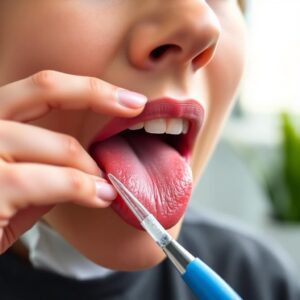
Understanding the Culprit: Your Oral Microbiome and the Tongue
To understand why your breath smells, you first have to understand the environment inside your mouth. Your mouth is home to a complex ecosystem called the oral microbiome, which consists of billions of bacteria—some good, some bad.
The good bacteria help you digest food and protect your teeth from decay. The bad bacteria, however, feed on leftover food particles, dead skin cells, and post-nasal drip. When these bad bacteria digest this debris, they excrete waste products known as Volatile Sulfur Compounds (VSCs). These sulfur compounds are the exact chemicals responsible for the foul, rotten-egg smell associated with bad breath.
So, where do these odor-causing bacteria like to hide? While some live on your teeth and gums, the vast majority thrive on the surface of your tongue.
Unlike the smooth, hard enamel of your teeth, your tongue is a spongy organ covered in tiny, hair-like bumps called papillae. These bumps create a rough, deeply textured landscape—essentially a microscopic forest where bacteria, food debris, and dead cells get easily trapped. Over time, this buildup forms a white or yellowish biofilm on the surface of your tongue. If you stick your tongue out and see a white coating, you are looking directly at the source of your bad breath.
Why Brushing Your Tongue Isn’t Enough
Many people recognize that they need to clean their tongue and attempt to do so with their toothbrush. While this is better than nothing, it is highly ineffective.
Think of it like trying to clean a plush carpet with a broom. Toothbrush bristles are specifically designed to sweep sticky plaque off the smooth, hard surfaces of your teeth. When you use those same soft bristles on the spongy, heavily textured surface of your tongue, you are mostly just moving the bacteria around. You might loosen some of the surface debris, but you are actually pushing a lot of the bacteria deeper into the crevices of the papillae.
Furthermore, brushing your tongue often triggers a severe gag reflex, causing many people to give up before they have thoroughly cleaned the back of the tongue, which is where the highest concentration of odor-causing bacteria lives.
What is a Tongue Scraper?
A tongue scraper is a small, inexpensive, U-shaped tool specifically designed to clean the surface of the tongue. They are typically made from stainless steel, copper, or medical-grade plastic.
Instead of sweeping like a brush, the flat, curved edge of the scraper is designed to glide over the papillae, acting like a squeegee. It physically lifts and removes the biofilm, bacteria, and debris from the crevices of your tongue in one fluid motion, pulling it entirely out of your mouth.
Top Tongue Scraping Benefits
Incorporating a tongue scraper into your daily routine takes less than 20 seconds, but the tongue scraping benefits are immediate and profound.
1. It is the Best Way to Cure Bad Breath If you are wondering how to cure bad breath, this is step number one. Clinical studies have shown that tongue scraping significantly reduces the production of Volatile Sulfur Compounds. By physically removing the bacteria and the food source they feed on, you eliminate the odor at its source, leaving you with genuinely fresh breath that lasts all day, rather than just masking it with a mint.
2. Enhances Your Sense of Taste When your tongue is coated in a thick layer of bacteria and dead cells, your taste buds are physically blocked. Many patients who begin tongue scraping report that their food tastes much better and more vibrant. By clearing away the biofilm, you expose your taste buds, allowing you to fully experience the flavors of your meals.
3. Balances Your Oral Microbiome By removing the heavy load of bad bacteria from your tongue, you help rebalance your overall oral microbiome. A healthier microbiome means less plaque formation on your teeth, a lower risk of cavities, and a significant reduction in your risk for gingivitis and gum disease.
4. Boosts Overall Immunity Your mouth is the primary gateway to your body. When you scrape your tongue, you are removing toxins and bacteria before they have the chance to be swallowed and enter your digestive tract. This reduces the burden on your immune system and promotes better overall systemic health.
How to Use a Tongue Scraper Correctly
Using a tongue scraper is incredibly simple and should be done every morning before you eat or drink anything. Here is the step-by-step process we recommend at Thompson’s Family Dentistry:
- Stand in front of the mirror and open your mouth wide.
- Stick your tongue out as far as comfortably possible.
- Hold the two ends of the scraper and place the curved edge at the very back of your tongue. (Place it as far back as you can without gagging. With practice, your gag reflex will diminish).
- Apply gentle, firm pressure and slowly pull the scraper forward toward the tip of your tongue. You will immediately see a thick, yellowish or white residue collect on the tool.
- Rinse the scraper under warm water to wash away the debris.
- Repeat this scraping motion 3 to 5 times, rinsing the tool after each pass, until the scraper comes away clean and your tongue looks pink and healthy.
- Wash your scraper thoroughly with soap and water, and store it in a dry place.
- Follow up by brushing and flossing your teeth as usual.
Get Personalized Advice at Thompson’s Family Dentistry
Adding a tongue scraper to your morning routine is a small, inexpensive habit that yields massive dividends for your confidence, your breath, and your oral health.’
However, if you have started tongue scraping, brushing, and flossing diligently, and you are still struggling with chronic bad breath, it is time to give us a call. Persistent halitosis can sometimes be a warning sign of an underlying issue, such as advanced gum disease, a hidden cavity, a chronic sinus infection, or a gastrointestinal problem.
During your comprehensive exam at Thompson’s Family Dentistry, we can identify the true cause of your bad breath and help you establish a targeted treatment plan. Don’t let bad breath hold you back from living your life confidently. Contact Thompson’s Family Dentistry today to schedule your next appointment! Call Us today @ 910 875-3625
 Previous Post
 Next Post